Feelings from the 2026 'Responsible' AI hackweek
Notes on attending the 2026 Responsible AI Hackweek in Seattle, USA 🇺🇸 from 24-28 Aug 2026.
- Program schedule: https://responsible-genai.hackweek.io/index.html?jump_to=schedule
- Jupyter Book: https://responsible-genai.hackweek.io/intro.html
Photo of the Hackweek venue in the University of Washington.

Since the start of the year, I've been burrying my head in the sand, trying to preserve my cognitive capabilities from the onslaught of colleagues, friends and even family that have succumbed to LLM-based 'AI' in one form or another. Frankly, I've been sad, seeing professionals I've once admired cave in to the agents, disheartened at friends and regular people on social media augmenting their interactions in slop speak, depressed maybe that even my partner is addicted to ChatGPT for translations/search to something akin to psychological therapy (cue ELIZA).
That's changed after this week, after attending a hackweek, about 'Responsible AI', that maybe wasn't responsible for me to fly over the Pacific Ocean for, but that I really really needed. Mainly to see, if there's still hope for humanity.
As one of the organizers said, the week felt like vacation meeting so many friends and cool people.
To me, it was like therapy, vacation, and an awakening, all at once.
Overall impressions
Compared to my last hackweek in 2024, this time round was smaller (~40+ people?), with a stronger skew of speakers from the industry instead of from academia, and maybe less students overall compared to postdocs or senior level researchers and staff from NASA (who sponsored the event) headquarters, DAACs (NSIDC, ASF), etc. The attendees were pretty much all US-based, except for me and someone else in Canada I think, probably due to the very last minute organizing compared to before (I only got formally invited in July). In some sense, the short time to prep made sense, the technology is fast moving and topics might become outdated in a month; best practices might not have solidified yet but the wide-ranging impacts meant we definitely needed to start talking about our principles/values and maybe come up with ethical guidelines before things get even more widespread.

The tutorials or lectures should eventually show up on https://responsible-genai.hackweek.io/tutorials/index.html, covering things like Model Context Protocol (MCP) and AI-ready data/metadata standards, secure sandboxing, etc. Projects people hacked (mostly in the afternoon) on things like NASA Earth data discovery/access, making documentation pages more agent-friendly, science use-cases like wildfires or marine ecosystem modelling, and so on.
Overall, it was super chaotic, with demos backfiring due to non-deterministic LLM behaviour, people coming up with the most absurd prompt engineering hacks, and confusion overall on choices between MCPs vs skills, >=2 workflow patterns, etc. Yet it all worked, the format f*cking worked. Engagement in terms of Q&A was like an order of magnitude more than any other conference I've seen in my entire career, people emphatized with the struggles of correcting agentic nonsense, and if you actually used your brain enough, maybe you can feel some resemblance of a consensus coming together towards the end of the week.
Sure, perhaps the 'Responsible' aspect didn't feel evident until the last few days.
But I felt that there is still hope, and I hope the next few sections give you a flavour of why I feel that way.
Token-optimization -> Human connection
I brought up the concept of 'token-optimization' in my talk, but I feel the need to emphasize, that optimizing for mechanical agents doesn't mean that we can't also improve the human experience. A good example was shown during a NASA Librarian project presentation (slides), where a team found that agents had a strong preference for suggesting MODIS data over NISAR data.
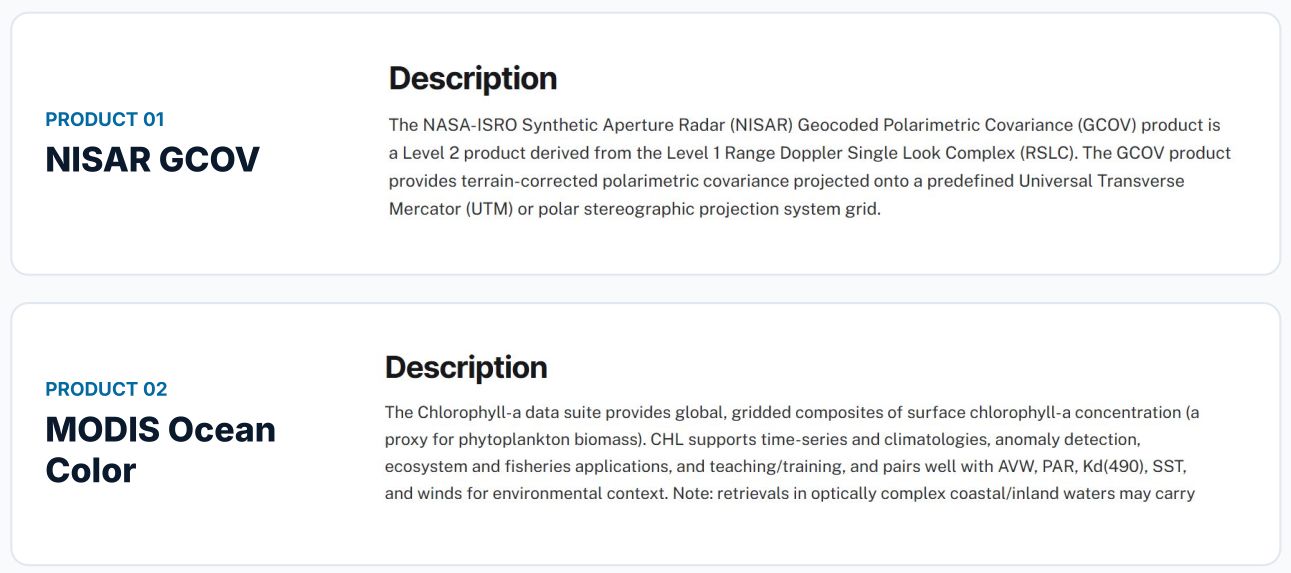
If you read the descriptions between the two, you could tell that the MODIS dataset's product description is much easier to comprehend on whether it will be useful for a particular task, whereas the NISAR one is full of technical jargon that might not mean anything to a non-SAR expert. Even the SAR expert in the room interjected that the MODIS description was much nicer.
Secretly though, I want to use 'token-optimization' as the cool (fundable) synonym for 'human'-optimization. Someone brought up a very good point that 'AI' has been used to plaster over many underlying 'problems'. One reason why people like agentic interfaces is because they don't want to waste time looking over PDFs or scattered websites looking to see if some data product fits with their science use-case. But the underlying issue might be that the documentation, or metadata, might not have been accessible in the first place. Or actually, that people are just time constrained - being asked to do more on less time (with the same pay) in the pursuit of 'productivity'.
Same goes for things like using agents to write proposals, might the whole grant/funding system been flawed all along? Or the proliferation of agents being used to assist in paper writing, exposing the stupidity of the publish-or-perish culture.
When the topic of how we should change our 'incentive structures' to align with the current reality, there was deafening silence for a while. I'll say the quiet part out loud. Some of us, me included, grew up on such incentive structures, and it is difficult to see alternative structures when your paycheck and career progression depends on it.
So just as money is/was used as an exchange for someone's time/effort, expending tokens have become the new way of throwing money at a problem. Fundamentally, we are toying with abstractions on top of abstractions on top of abstractions. Whether such multi-layered abstractions will stand the test of time is to be decided, and I'll come to mention ideas on how people have been thinking of making those abstractions more robust (whether they make sense or not) later below.
But I hope that you, hopefully a human, reading this, recognize what might happen if we take things to the extreme.
The tried and true
I'll discuss two things that are reasonable 'standards' with some weight behind. Whether or not they should be used at all, or are relevant for everything depends on your use-case, but anyways.
Model Context Protocol (MCP)
Tuesday Slides 1 from Joe Hamman (Earthmover) and Slides 2 from Jason Gilman (Element84).
Anyone involved in the agentic space should have heard about MCPs by now, so won't go into detail here. If I had to nitpick, the JSON(-RPC) transport feels old-school (see GeoJSON -> GeoParquet), but I suppose it is the lowest common denominator. Protocol-wise though, it has fulfilled its job of getting everyone to use a common communication system compared to the M x N combinatorial explosion before.
A critique I have (not on the protocol itself) is more on the ecosystem level. I felt a sense that many folks at the hackweek wanted to build an 'MCP for X' for some reason, but... just because you can doesn't mean you should? How MCPs should interact or be chained with one another wasn't clear, and alternatives (touched on later below in sections below) didn't seem to register so much in people's minds for whatever reason.
GeoCroissant
Wednesday Slides from Rajat Shinde (NASA ODSI).
Croissant is a metadata standard built on top of schema.org, GeoCroissant adds geo-specific concepts, and Croissant 1.1 spec is 'Agent-ready'. If I had a penny from everyone who said they wanted to build some MCP to make dataset X more discoverable and accessible to agents, I would invest $1 (100x) into Croissant instead. Why? Because good metadata, that is both human- and machine-readable (see 'Token-optimization' above) beats over-engineering unwieldy interfaces that will likely be obsolete in months. Metadata is forever.
The case for (Geo)Croissant becomes even more important when you want to combine multidisciplinary datasets.
Without Croissant, each dataset might have a different metadata schema (if any at all), or god forbid, an MCP server, and can you imagine the tokens being chewed through as your agent tries to reconcile the differences.
With the Croissant standard?
Easy(ier), just one consistent way to parse the metadata, and (Geo)Croissant's integration with the mlcroissant library means you can get an easier end-to-end ML data pipeline going (see https://ieee-grss-veda.github.io/veda-dcai/Introduction_to_GeoCroissant/Introduction_to_GeoCroissant.html as an example).

Overall, these two 'standards' (GeoCroissant, and I guess MCP), or at least the idea/concept of them, are good to consider if you know what you're doing.
The fuzzy
This section is where concepts feel like they are on the way to getting canonicalized, but might take another year (or maybe just months) to become 'best practice'.
AI-ready data
Wednesday slides from me!
My hot take was that cloud-optimized != AI-ready, and then I went on about how data could be made more 'AI-ready' in two aspects:
- For faster ML training. Simplify the data structure/spec by discarding unnecessary parts. See e.g. TIFF -> Cloud-optimized GeoTIFF -> TACOTIFF/RUMI
- For 'agent' usage. Think of it as data stored in digital twins which are multi-modal and require frequent updates. See Multiversion concurrency control in e.g. Zarr -> Icechunk for n-dim formats; Parquet -> Lance for tabular.
Or if you're stuck with shapefiles, just add .md and .skill sidecar files.
Workflow patterns
Tuesday slides and repository by JP Swinski (NASA Goddard), Lilly Thomas (DevSeed), Ellie Abrahams (Stanford uni)
How does one achieve some structure from non-deterministic agent outputs? Well, you could tell that lots of trial and error went into this session from the three speakers. Depending on whether you have a well-defined/bounded problem, or a more open ended/'research'-type task, you might want to reach for different workflow patterns.
Lilly demo-ed a tool-using-agent that takes a very structured approach in the footsteps of the ReAct pattern, using a minimal amount of tokens ($0.01 with caching?) and templated responses. Ellie walked us through a 'Research -> Plan -> Implement' pattern that is a lot more expensive (since sub-agents were spun up), but seems like a recommended way to prompt agents to do your bidding.
AGENTS.md and SKILL.md
Monday slides from Anthony Arendt (UW eScience) and Joachim Meyer (Boise State University)
I like the framing of 'always present' <-> 'on-demand' spectrum.
There seems to be a gradual settling on AGENTS.md and SKILL.md as the filenames to use, instead of model-specific names.
Where the files go (in the top-level directory? inside .agents/skill-something/SKILL.md?) seems arbitrary still.
You could go as far as treating SKILLs as packages, but I'm starting to get a headache thinking of constraining SKILLS to specific versions of a package and keeping them up to date...
At the end of the day, context or prompt engineering is ... flaky. What to put inside the files seems like a dark art (all CAPS, progressive disclosure, guardrails, etc). One good thing perhaps is that they're flat files, so cheap to store unlike MCP servers that need to be kept running. Then I suppose the question is: When do you use an MCP vs an AGENTS.md vs a SKILL.md vs ...?
Sandboxing and evals
Thursday slides from Mike (AI2)
Go read https://allenai.org/blog/shippy-deep-dive. Mike gave a really good talk on how they shoehorned nondeterministic agents into using deterministic tools (skills referencing a CLI). Do that in a proper sandbox (they referenced 'Mothership', not open sourced yet), and score the behaviour properly (eval framework built on Harbor), and you get ... a product that feels as maintainable as can be in this agentic world.
There were some interesting little details in the talk that caught my attention. Such as:
- They have classifier- instead of prompt-based guardrails for things like military intent (which you wouldn't want an LLM to be jailbroken for).
- They started with an MCP for Shippy, but change to a Skill/CLI approach. Reasoning seemed to be pragmatic, they controlled the whole server/client so didn't need to update SKILLs in many places, whereas if you couldn't control the clients, maybe MCP is a better fit (at the expense of server management).
- Not 100% foolproof. There was a demo after the main presentation on a earthquake-watch. And even though the agent was instructed not to predict earthquakes, some folks were able to get the agent to say "No earthquakes in Seattle for next week", which is technically still a prediction.

All in all, it does feel the community is grasping at some notion of what can be done to make agentic-AI saner, be it AI-ready (meta)data format designs, reproducible-ish workflow patterns, context/prompt engineering tricks, secure sandboxes, etc. The implementation itself is still all over the place, and wheels kept getting reinvented over and over again.
One could take a step back and argue - are we gaining anything from this at the expense of nondeterministic behaviour and negative ethical/environmental impacts?
The uncertain
Not sure about you, but scientists thrive on (reducing) uncertainty, and this is the space that deserves the most attention.
Landscape of coding agents - closed or open?
Monday slides by Anthony Arendt, Anshul Tambay, Don Setiawan (UW eScience)
This was the first tutorial that set the stage. Basically agent = LLM + harness. Or you could say, there are multiple layers to the whole 'agentic stack', each one with varying levels of openness.
Early this year, it was commonly said that pay-for-access frontier models were more 'capable' than open models. Now, as of September 2026, you could argue that a gap still exists, but I will say that you're paying more for convenience (in terms of someone running the whole infra) rather than actual next-word/token-prediction capability that open weight models '3-6 months' behind now have. If you do the math, minus 6 months behind is early 2026, when those sales pitches on using frontier models were originally made.
Sure, not everyone has a capable GPU on their workstation to run a local-first model, but I can see how it might make sense on an institutional basis, have some sysadmins (is that still a word?) set up a node on their HPC running an open weight LLM, and allow users to connect to it. Oh, but of course, they'll then realize how much electricity these things actually cost, how much tokens are subsidized, and ...
Responsible/trustworthy AI
Thursday/Friday live discussions
This brings us to the namesake of the hackweek itself.
The three principles for the week were "Robust, Reproducible, Secure". I would say that surprisingly, we made good progress on these three aspects - we've learned how to context engineer agents to some semblance of robustness, ensure that we document and version the artifacts agents produced (especially the code) to keep things reproducible, and learned about sandboxing techniques to keep things secure.
Haha, but I'd be kidding you if this means we're responsible, and I think many people attending, being Earth scientists, were aware of the social, environmental and ethical costs incurred in propping up this agentic economy.

Those of us who stayed on Thursday did this exercise to write down things agentic AI can do, and place them on a risk/reward 4 quadrant. On the left, you have the low risk/low reward stickies. Things like chatting to an agent about some dataset, slightly glorified search. Towards the right, as the potential rewards increase, the risk spread increases. More automation could help us a lot, but also more things could go wrong.
In some cases, there are ways to lower the risk by adding a human-in-the-loop for example (upper right to bottom right quadrant). Or you could increase the reward/impact by expanding the use-case to more users (lower left to lower right quadrant). I think it is important to consider what people, including those not in the room, actually want, and whether our planet Earth can sustain the costs associated with it.
What is inevitable vs what is not
I don't think "Agentic AI all the way" is inevitable, at least not in its current form using inefficient Transformer-based architectures (talk to me if you find state-space model-based agents). To the few students I've chatted to at the conference, I told them this - don't rely on (non-deterministic) AI, rely on (and develop) your critical thinking.
Personally for me, I want to be able to separate the human from the AI. We talk about AI tools helping us do science, but I was taught that science is less about what we know now, rather, it is what we want to find out next. Some people see the process of getting to the next big thing as a chore, I see each slow step as an opportunity to uncover serendipitious findings.
Lastly, I want to echo a quote one of my colleagues mentioned at the conference, that "Human readable content should be created by humans". I do hope you found this blog post readable 😉.